

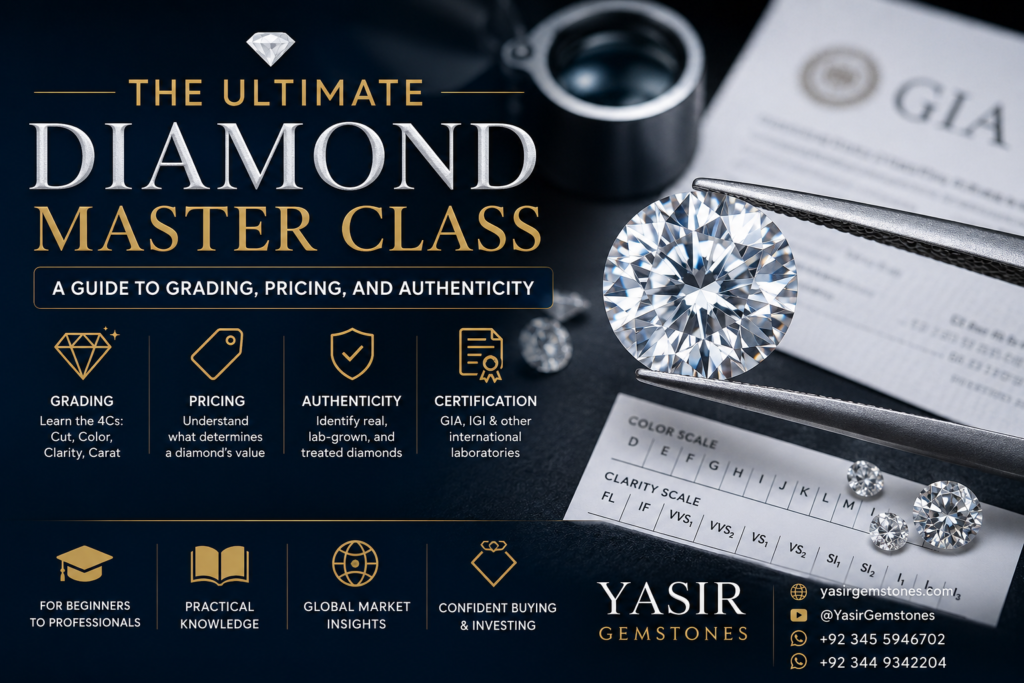
Diamond Master Class is your complete guide to understanding the world’s most valuable gemstone from a scientific and gemological perspective. While diamonds are often seen as simply “shiny stones,” their true value lies in their formation, grading, pricing, authenticity, and rarity. Whether you are an investor, jewelry enthusiast, or student of gemology, this comprehensive guide will help you understand how professionals evaluate diamonds and make informed buying decisions.

The Science of Carbon: From Earth to Surface-Diamond Master Class
The story of a diamond begins 150 to 200 kilometers deep inside the Earth. Under high pressure and high temperature, carbon atoms arrange themselves into a specific crystal structure over millions. And sometimes billions of years. These stones eventually reach the surface through volcanic eruptions.
Interestingly, both diamonds and graphite (used in pencils) are made of carbon. However, while graphite is one of the softest materials (hardness 1–2), the diamond is the hardest natural material on Earth. Reaching a 10 on the Mohs scale. This hardness makes them ideal for industrial tools like drill bits that can cut through the toughest surfaces
“If you want to learn more about the history and benefits of individual stones, explore our detailed Blogs“
Understanding the 4Cs of Diamond Grading-Diamond Master Class
When buying a diamond, its value is determined by four critical factors known as the 4Cs.
A. Color Grading (D to Z)
The Gemological Institute of America (GIA) created a color scale ranging from **D to Z**.
* D, E, F These are completely colorless and transparent.
* G, H, I, J Known as “near colorless”.
* K, L, M These stones have a slight yellowish tint.
* N to Z These range from light yellow to deeper yellow tones.
* Fancy Colors Occasionally, trace elements like iron or titanium turn diamonds into rare shades of blue, pink, red, or yellow . A famous example is the Hope Diamond.

B. Clarity: The inside World of the Stone
Diamonds often contain “inclusions” (internal) or “blemishes” (external). Common inclusions include carbon crystals, feathers (cracks), clouds (groups of tiny feathers), and pinpoints.
* FL (Flawless) / IF (Internally Flawless): No inclusions visible; these are extremely rare museum pieces.
* VVS1 / VVS2 Very, very slightly included; common in high-end jewelry.
* VS1 / VS2 Very slightly included.
* SI1 / SI2 Slightly included; inclusions may be visible under a magnifying loupe.
* I1 to I3 Imperfect or poor quality with many visible inclusions.
C. The Importance of “Cut”
The Cut is perhaps the most important “C” because it determines a diamond’s brilliance (sparkle). A diamond has several parts: the Table, Crown, Girdle, Pavilion, and Culet. If a diamond is cut poorly, light leaks out of the sides, and the stone looks dull. A masterfully cut diamond reflects light back to the eye, creating that iconic sparkle.

D. Carat (Weight)
Carat refers to the weight of the diamond. However, a larger carat does not always mean a more beautiful stone if the cut or color is poor.
Diamond Treatments: Enhancing Nature
Many diamonds undergo treatments to improve their appearance, which can significantly affect their price.
* Laser Drilling Used to remove dark carbon inclusions.
* Fracture Filling Filling internal cracks with glass.
* HPHT (High Pressure High Temperature) A heat treatment to enhance color and clarity.
* Irradiation Using radiation to change a diamond’s color (e.g., turning a yellow diamond blue or green).
*Note: While diamonds are the hardest material, they are “brittle,” meaning they can still fracture or crack if hit hard enough—hardness is different from toughness.
4. How Prices are Calculated
Diamond prices are not just about weight; they are a combination of all the 4Cs.
Diamond pricing is more complex than simply checking the carat weight. Two diamonds of exactly the same weight can have significantly different values depending on their color, clarity, cut quality, and overall visual performance.
The 4Cs work together when determining a diamond’s value. A well-cut diamond with an attractive color and clarity grade may command a higher price than a larger diamond with poor proportions, visible inclusions, or weaker light performance.
Other factors can also influence the price, including the diamond’s shape, fluorescence, proportions, polish, symmetry, treatment history, and grading report. Whether a diamond is natural or laboratory-grown is another critical consideration, as these categories have very different market values.
For example, two one-carat diamonds may look similar to an inexperienced buyer but differ considerably in price after professional grading. This is why buyers should avoid judging a diamond by carat weight or appearance alone.
At Yasir Gemstones, we recommend evaluating the complete grading profile and verifying the laboratory report before making a high-value diamond purchase. A diamond’s true market value is determined by the combination of its quality characteristics, identification, and current market demand.

5. Expert Tips for Smart Buying( Where to Buy a Diamond)
1. Cut Over Carat: A 0.90-carat diamond with an “Excellent” cut will often look more beautiful and sparkling than a 1.20-carat diamond with a “Poor” cut.
2. Look for “Adamantine Luster”: If you aren’t an expert, look at the stone’s overall brilliance; it should be highly reflective and attractive.
3. Demand Certification: Never buy an expensive diamond without a certificate from a reputable lab like GIA, IGI, GRS, or Guild.
4. Verify the Dealer: Check the authenticity of the seller through Google reviews, social media interactions, and customer feedback before investing.

Diamonds are more than beautiful gemstones—they represent a unique combination of science, rarity, craftsmanship, and enduring value. We hope this Diamond Master Class has given you the knowledge and confidence to understand diamond grading, pricing, authenticity, and the factors that determine a diamond’s true worth. Whether you’re purchasing your first diamond, investing in fine gemstones, or expanding your gemological expertise, informed decisions always begin with reliable education.
At Yasir Gemstones, our mission is to make professional gemstone education accessible while offering ethically sourced, carefully selected natural gemstones with complete transparency and expert guidance. Explore our educational resources, browse our premium gemstone collection, and connect with our team for trusted advice before your next purchase. We look forward to helping you build knowledge and confidence in the fascinating world of gemstones.
Sau vài hôm trải nghiệm sportzfy apk download apkpure , mình cảm thấy mọi thao tác đều khá dễ dàng và thuận tiện. TONY08-26